Qwen AI Explained: Capabilities and Real-World Applications
Artificial intelligence continues to redefine how content is created, automated, and scaled. Among the fastest-evolving areas is AI that understands and generates visual content — not just based on simple prompts but with deeper semantic understanding. One such model gaining momentum is Qwen AI, a next-generation multimodal AI system designed to bridge text, images, and creative workflows.
In this article, we’ll explain what Qwen AI is, its unique capabilities, and how it’s being used in real-world applications — from creative generation to business solutions. We’ll also highlight how content creation platforms like InVideo have integrated Qwen AI directly into their tools, enabling creators to access advanced AI features without technical barriers.
What Is Qwen AI?
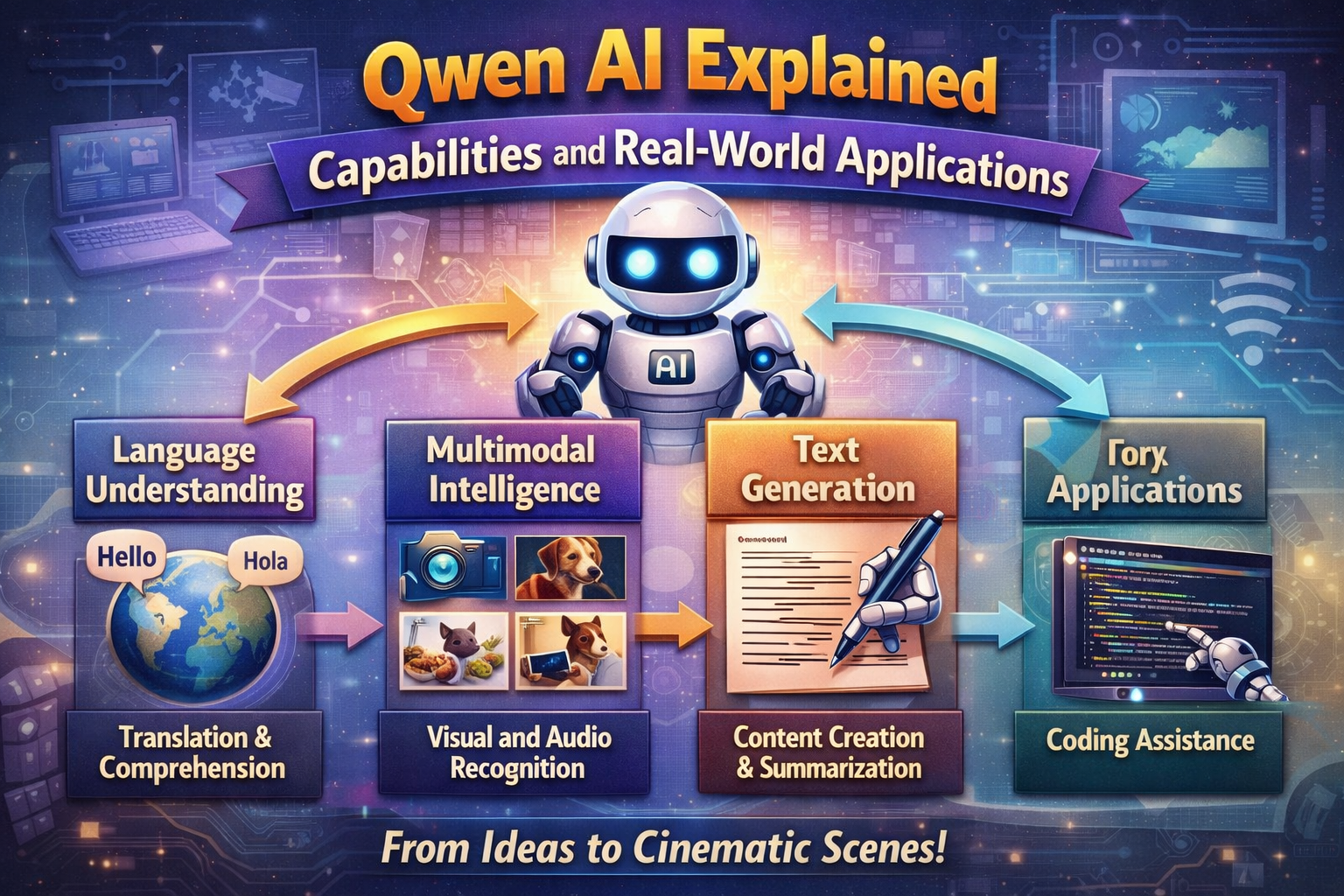
At its core, Qwen AI is a multimodal artificial intelligence model capable of processing and generating content across different formats — including text and images. Unlike early AI systems that focused solely on text or visual generation, Qwen AI understands relationships between language and imagery in more complex ways. This makes it a powerful tool for creators, marketers, designers, and businesses looking to generate content that feels contextually intelligent, visually coherent, and semantically accurate.
Qwen AI’s capabilities extend beyond simple prompt responses. It leverages deep learning architectures that integrate visual understanding with language reasoning. This enables outputs that are not just visually attractive but also meaningfully connected to the input text.
Core Capabilities of Qwen AI
Understanding the capabilities of Qwen AI helps us see why it’s becoming widely adopted across sectors.
1. Multimodal Understanding
Qwen AI can handle both text and image inputs simultaneously. For example, you can feed it a photo with a caption question like “What is happening in this scene?” and receive a coherent, context-aware explanation. This bridges the gap between simple image tagging and deep semantic understanding.
2. Image Generation and Manipulation
Unlike models that only generate text, Qwen AI can produce detailed and stylistically diverse visual outputs based on natural language prompts. This includes photorealistic scenes, illustrations, conceptual visuals, and design variations. The result is richer visual creativity without complex editing workflows.
3. Enhanced Contextual Awareness
Qwen AI doesn’t treat each request independently. It can consider a broader context across conversations or multi-step instructions, enabling more accurate and useful results. This is especially helpful in scenarios where users refine prompts for iterations.
4. Text-to-Image and Image-to-Text Workflows
Qwen AI supports both directions of interaction — generating visuals from text descriptions and extracting meaningful textual summaries from images. This bidirectional capability makes it a versatile tool in creative and analytic workflows alike.
5. Efficiency and Adaptability
Built on robust training datasets and optimized architectures, Qwen AI offers quick generation times with high-quality outputs. It is also adaptable, meaning it can be employed for various creative aims — from generating unique visuals to supporting automated content pipelines.
How Qwen AI Is Used in Real-World Scenarios
The power of Qwen AI shines through when we examine how people and organizations actually use it.
Content Creation and Social Media
Creators need visuals that grab attention quickly. With Qwen AI, they can generate concepts, backgrounds, or themed images for posts without relying on stock media or manual design tools. The ability to produce relevant and unique visuals on demand accelerates workflow and increases creative flexibility.
Marketing and Advertising
Marketers often require tailored images for campaigns that align with brand voice and messaging. Qwen AI enables rapid generation of ad visuals, banners, and thumbnails that match given brand prompts. This reduces turnaround time and supports A/B testing across audiences.
E-Commerce Visuals
E-commerce platforms often need product visuals, lifestyle photos, and promotional graphics. Qwen AI can generate product scenes, backgrounds, or complementary images that enhance product listings without costly photoshoots.
Education and Training Materials
Teachers and instructional designers can use Qwen AI to generate illustrations, infographics, or explanatory visuals that support learning. This helps make complex concepts more digestible, especially in digital or remote learning environments.
Design Prototyping and Ideation
Designers can leverage Qwen AI to explore visual ideas quickly before committing to detailed production. Whether it’s concept art, UI elements, or mood boards, the model can generate options that spark inspiration and streamline the creative process.
Automated Reporting and Visual Summaries
Businesses analyzing visual data — such as charts, photos, or scanned documents — can use Qwen AI to extract meaning and provide clear summaries. This supports data storytelling and shortens the path from input to insight.
Invideo Integrates Qwen AI for Easy Access
As powerful as Qwen AI is on its own, its integration into broader creative tools elevates its usability for everyday creators. One such platform that now provides direct access to this AI technology is invideo.
With the integration of Qwen AI, invideo users can generate compelling visuals directly within the platform. This allows creators to enhance video projects, thumbnails, and supporting visuals without leaving a single workspace. Using natural language prompts, creators can request specific imagery — such as scenic backgrounds, brand visuals, or themed illustrations — and receive AI-generated output that fits their creative intent.
This native integration simplifies workflows for content creators who want strong visuals to complement their storytelling without switching between standalone AI tools and video editors. Instead of exporting images from one platform and importing them into another, creators can handle everything from ideation to final editing within invideo.
This makes invideo’s offering stronger, especially for travel vloggers, brand storytellers, social media managers, and marketing teams who rely on quick visual generation as part of their regular workflow.
Benefits of Using Qwen AI in Creative Workflows
Bringing Qwen AI into everyday content creation leads to several key advantages:
Faster Turnaround
Traditional visual creation can take hours or days. Qwen AI significantly reduces production time by generating visuals almost instantly from descriptive inputs.
Reduced Need for Design Expertise
Creators don’t need expert design skills to produce compelling imagery. Qwen AI opens up visual creation to anyone who can describe what they want.
Consistent Style and Quality
With well-crafted prompts, users can generate a series of images that follow stylistic rules or thematic consistency — essential for branding and professional presentation.
Cost Efficiency
By replacing or supplementing traditional design work, Qwen AI lowers the cost associated with visual production, especially for small teams or independent creators.
End-to-End Creative Support
From concept to final execution, Qwen AI helps across the creative pipeline — ideation, iteration, and output — which accelerates project timelines.
Best Practices for Working With Qwen AI
Like any powerful tool, getting the most out of Qwen AI requires thoughtful input and iteration.
Be Specific With Prompts
Clear, descriptive language leads to more accurate outputs. Include style cues, mood, color references, and any necessary context.
Iterate Gradually
Start with a basic prompt and refine with additional details based on generated outputs.
Use Reference Materials
When possible, provide visual references or examples to guide the AI toward your desired end result.
Combine With Editing Tools
Generated imagery can be refined further using editing platforms for fine-tuning or integrating into larger projects.
Test Across Formats
Visuals can be tailored for different dimensions and platforms — such as mobile, desktop, or print — to maximize usability.
The Future of AI Like Qwen AI
As AI continues to evolve, tools like Qwen AI become more capable, context-aware, and integrated with broader creative workflows. Future developments may include:
- More intuitive natural language interaction
- Better integration with multiple media formats, including video
- Faster generation with higher resolution outputs
- Enhanced style controls and adaptability to user preferences
These advancements point toward a future where visual content creation becomes more accessible, faster, and deeply responsive to user needs.
Conclusion
Qwen AI stands out as a next-generation model that brings multimodal capabilities to the forefront of content creation. Its ability to understand and generate visuals from complex descriptive directions makes it useful across industries and creative workflows. From marketing and social media to design ideation and education, Qwen AI helps creators produce meaningful, engaging images with speed and flexibility.
With an AI video creator like invideo integrating Qwen AI directly into their platforms, creators can now access advanced visual generation features without breaking the flow of their content creation process. This streamlines production, reduces friction, and unlocks new possibilities for storytelling in a visual world.
As AI models continue to improve, tools like Qwen AI are likely to become even more central to how digital content is created, shared, and experienced.